


INSIGHT
7 Line-Marking Robot Myths That Could Cost You Time & Money
The Art and Science of Robotic Line Marking
It’s amazing what you hear when you take the time to listen to your customers. We do demos every day and talk to hundreds of people. These are the questions we get most often.
In this post, we address them one by one and give you the common-sense tech and science behind them. You’ll learn how to separate fact from fiction to make the best decision for your organization. You’ll learn how to separate the sales pitch from the engineering. While many of these claims sound logical in principle, they don’t tell you what determines performance on your field.
These seven questions will help you compare systems based on the real science behind the technology.
1. Does a line-marking robot need an on-site base station to be accurate?
No.
A base station is one way to deliver correction data to an RTK-GNSS receiver. It’s not the only way.
Network RTK services use permanent, continuously operating reference stations and deliver corrections over a cellular connection. Both approaches can provide centimeter-level positioning when properly engineered and operated.
2. Will a system without a base station drift due to the movement of the Earth?
No.
Receiving RTK corrections through a network rather than a base station won’t cause the layout to move. Think about the GPS in your phone. Your home address does not appear several inches farther down the street every year because the Earth is moving. Modern positioning systems account for that movement.
A saved field layout works the same way.
Modern GNSS positioning relies on established reference frames and correction services. The Earth rotates, tectonic plates move, and geodesists account for that movement in the coordinates and velocities positioning networks use.
Ask your vendor to paint a saved field and then return to repaint it. Repeatability is something you can test. You don’t have to take our word for it.
3. Does a heavier robot paint a straighter line?
No.
Weight has nothing to do with how the robot handles. It has to do with positioning accuracy, control logic, traction, wheel geometry, speed, terrain handling, and paint delivery. In other words, a bunch of factors affect line quality, but weight isn’t one of them.
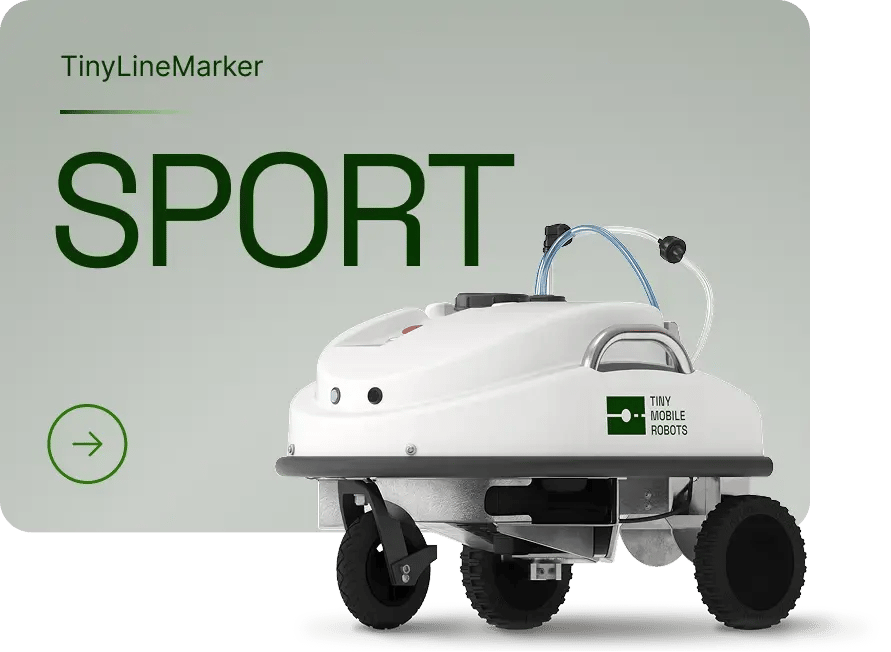
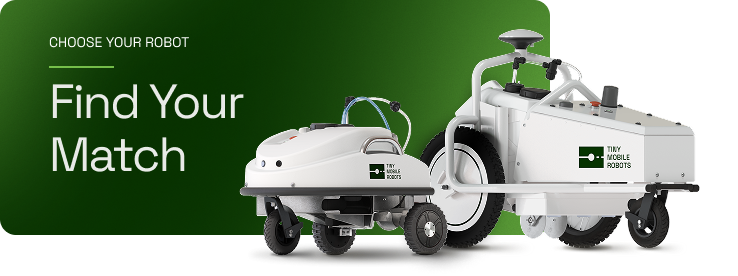
In fact, extra weight can create practical problems. Your crew, whether paid or volunteers, still has to load and unload the robot, move it between fields, and transport it. A heavier machine may require more people or even additional equipment. (And if you’re dealing with volunteers, you don’t know who will be doing the painting, but whoever it is needs to be able to lift the robot and get it into whatever vehicle is available to them. Our smallest model weighs just 55 pounds and fits in the trunk of any vehicle.)
Judge the finished result. Look at straight lines, curves, corners, numbers, and logos. The number on the scale won’t affect precision.
4. Is a lighter robot too flimsy for uneven fields?
No. TinyMobileRobots were engineered specifically for that.
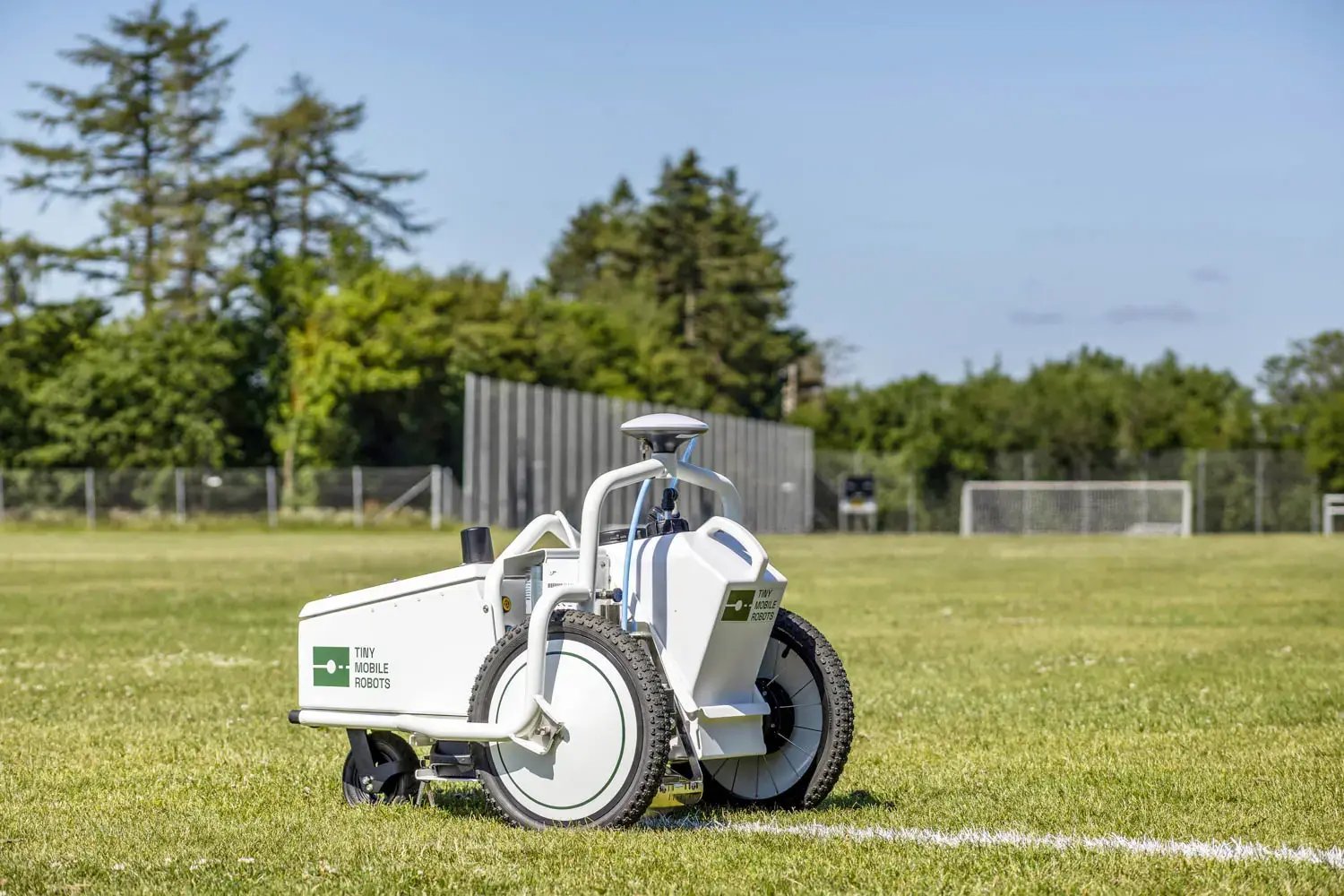
The purpose-built chassis combines portability with the stability needed for accurate marking. TinyMobileRobots began with precision land-surveying robots designed to travel over dirt, rocks, and irregular terrain. Our line-marking robots are the next generation of that same hardy engineering.
Have your sales rep run the robot on your most cantankerous field and inspect the finished lines. You’ll quickly find that size isn’t an indicator of performance.
5. Is leasing smarter because you receive a new robot every few years?
Only if permanent payments fit your organization’s strategy.
A replacement cycle sounds great. It’s like protection against obsolescence. Nonetheless, it also means your organization never owns the asset.
Evaluate ownership, financing, lease-to-own, and seasonal payment options against your budget and expected use. No single payment model is right for every organization.
To figure out which option might be best for you, compare the total cost of the robot over the number of years you’ll use it. Consider all the costs you might incur. Include subscriptions, paint requirements, batteries, accessories, support, and end-of-term conditions. Ask about what happens to the robot at the end of the agreement.
Of course, leasing might make the most sense for you right now, or even a pay-as-you-spray program. But don’t lock yourself into an agreement without analyzing the best option for your budget and long-term goals.
6. If I own the robot, will it become obsolete quickly?
Buying a line-marking robot is a major decision, and you want to be sure that you won’t have to replace the machine in two years. We engineer our machines to be sturdy and durable, and we operate in a continuous improvement loop. That means we are always working to make our robots better, and we take your feedback seriously. But here’s a powerful testimonial. 92% of our robots of all ages are still out in the field and working.
TinyMobileRobots has used the same core platform architecture for roughly a decade. That’s because it works. But we are also always adding software improvements and new capabilities. So, when talking to your salesperson, ask which improvements arrive through software updates. Ask which components can be repaired or replaced, and whether they continue to support older units.
Long-term value depends on serviceability, available parts, software development, and support throughout the robot’s life. By the way, our support team is the best in the industry–we have the numbers to prove it. 86% of all support tickets get resolved within 24 hours, and most within 1-2 hours.
7. What about after the demonstration?
Workflow and support matter as much as the specifications. A robot can look great at the demo, but none of that matters if your crew won’t use it.
Before making a decision, ask:
-
How long does setup take?
-
Does the tablet have to stay next to the robot?
-
Can the robot mark multiple fields without repeated setup?
-
Can you use the athletic field paint of your choice?
-
Does the system provide low-paint alerts?
-
How long does cleanup take?
-
Can support technicians diagnose problems remotely?
-
Can you provide on-site assistance, ongoing support, or a loaner robot when necessary?
-
What battery-powered components are needed to operate it each time?
These details determine whether the robot saves time and rework in real-world conditions, not just at a demo.
The Best Comparison Happens on Your Field
Don’t fall for pseudo-scientific claims.
Compare all robots side by side on the same field, and have each one paint the same layout. Test straight lines, tight turns, numbers, and even logos. Move each robot between fields. Get your crew involved in the decision, and ask them which unit they would willingly use. Compare total cost, financing options, and buying options to get the complete experience.
You might not buy our unit, and that’s okay. But make sure you know all the facts before you decide. A free demo lets you test accuracy, setup, portability, and ease of use on your fields, with your crew. And you can ask as many questions as you need to.
DISCOVERY CALL