INSIGHT![]()
Precision and Efficiency: How Robotics Revolutionizes Sports Field Line Marking
Painting playing fields for recreational and tournament sports is an endeavor that takes precision, planning, and experience to do well. Manually marking accurate field lines can be costly and time-consuming, but accurate layouts make an impression on anyone who encounters them. Different sports vary in boundary complexity, from the hash marks of American football to the half-moon arcs of women’s lacrosse, and take varying lengths of time to paint accurately depending on the method.
A tidy, professional field makes a difference to athletes, encouraging them to play better by eliminating doubt. Audiences and fans need to be able to see the field, too, to follow the action from the stands or sidelines. And referees can cancel games on unfit playing fields–clear, regulation lines are essential to fair adjudication. Adding details like sponsor logos requires additional equipment and experienced staff, but that support makes a difference to your bottom line.
Doesn’t it feel great to walk out onto a field as part of a hosting team, knowing it's well-kept? With manual methods, the process costs time, planning, skills, and resources. Fortunately, advances in robotic painting make it easier than ever to achieve accurate field lines.
Lining a Soccer Field the Hard Way
Measuring and marking a soccer playing field is simpler than other sports, but the manual process can still take two people an hour, as seen in this Creenbird video. First, the small crew measures the field and calculates the layout dimensions, using tape measures and teamwork to ensure their initial lines are accurate. This team uses aerosol paint to outline the outside field boundaries; your team might use a push paint sprayer. From there, success depends on accurate math, a methodical procedure, and experience.
After outlining the box and defining the field of play, soccer fields have several boxes, arcs, and circles to paint. These goal and penalty lines must be symmetrical and accurate–that’s where good math comes in. Using a string or measuring tape as a guide, the crew marks and paints interior straight lines. For the center circle and small arcs on either side of the soccer field, technique and experience make a difference in even, accurate paint application.
The initial paint yield from an aerosol or push paint sprayer can be too light for good visibility. After applying the first coat, a paint team might need to go over the lines again for crisp, game-day brightness, using 8 to 10 cans of spray paint. (Repainting the lines later takes about half that.) If you’re using aerosol cans, that cost adds up compared to concentrate field paint. The cans are lighter and easier to transport than push painters, but they aren’t ideal for everyone. Additionally, the disposal of aerosol cans can harm the environment, which may be a concern for green-minded parks and recreation departments.
Details Make a Difference
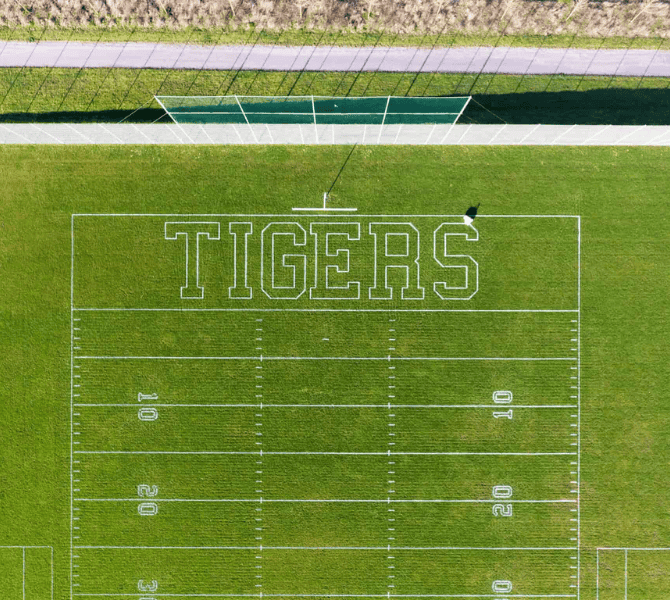
Soccer fields are among the simplest field layouts, so they can be completed in under an hour. For school athletic directors responsible for football fields, hash marks and endzone lettering add complexity and time. Crews can take up to 20 hours to manually mark an American football field, with a huge margin of error .
For example, your team might use stencils to add numbers and endzone lettering to the football field. These stencils have limited applications, so they might need to be replaced every year. Although a less experienced team member can use them, the stencils are only part of the complexity of the football field. It’s likely a football field will require a team of two or more people to complete in a day, and those labor hours add up quickly.
Plus, a large football field is an excellent place for sponsors to advertise. If you have a skilled field painter, they might be able to freehand or stencil your sponsor’s logo. However, if that time spent means other essential caretaking tasks aren’t completed, are your financial supporters getting their money’s worth? Details like sponsor logos in a beautiful, well-kept venue can be vital to fundraising and investment.
For directors responsible for many playing fields in a district or for many types of fields at once, painting a layout as complex as football requires good planning and resource management. Crews must account for travel, equipment transportation, play and practice schedules, and weather in addition to their measurements and supplies. Every step of the line-marking process must be carefully planned for a skilled team to paint a football field accurately, and mistakes can have a significant impact on the venue’s reputation.
Automation Makes Details Accessible
With intense time and labor requirements, manually painting fields is a taxing burden. Line clarity deteriorates over time due to mowing and weather–fading lines need to be repainted and maintained throughout the season. Few people possess the skills and experience to manually calculate and paint layouts, and rigorous outdoor schedules can be exhausting. Spending the majority of a crew’s time on painting layouts means less time for other caretaking tasks, such as picking up trash, nurturing the turf, and eradicating weeds.
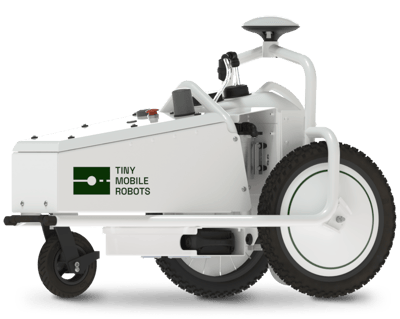
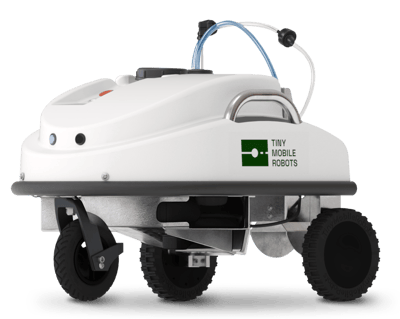
To save time and resources, athletic directors are considering the benefits of robotics technology to automate the process of marking field lines. Robots like the TinyMobileRobot utilize GPS to lay out and paint fields, eliminating the need for multiple crew members and ensuring accurate measurements. These robots make things easier:
Sports fields don’t have to be repainted regularly to prevent old lines from fading. The robot saves the layout and doesn’t need to see previous marks to paint correctly.
The connected tablet comes with pre-installed regulation layouts, and you can also upload your own. Match the layout to the map and let the computer do the complicated math.
Robots don’t need to be monitored constantly. The line painter notifies the tablet when there is low paint and when jobs are completed, allowing experienced staff to multitask.
The TinyMobileRobot can also handle your sponsor logos and mascot art. With accuracy down to .5 inches, school districts and parks and recreation departments can achieve professional-quality fields in a fraction of the time spent on manual painting. Elevating the look and feel of your venue attracts more sponsors and spectators. Automation gives your experienced staff a break from the physical labor of repeatedly walking the field.
High Time for New Technology
Maintaining playing field turf is easier, thanks to evolving technologies for mowing, seeding, aerating, and watering. These labor-intensive tasks can now take a fraction of the time and effort required, and a lush, well-kept field is more accessible than ever. To that end, shouldn’t accurate painting be quick and accessible, too? Robotics and GPS technology are TinyMobileRobots’ answer for athletic directors seeking beautiful, professional field lines. With a line-marking robot taking care of the layout, your crew is free to tackle all those other details that make your venue a welcoming spot for friendly competition.
LINEMARKING GUIDE![]()
The Ultimate Guide to Linemarking
Learn the exact process for painting football, soccer, and baseball fields.
PREMIUM GUIDE![]()
The Ultimate Guide to Linemarking
Learn the exact process for painting football, soccer, and baseball fields.
Which Robot is Right for You?
Related Posts
SEE ALL